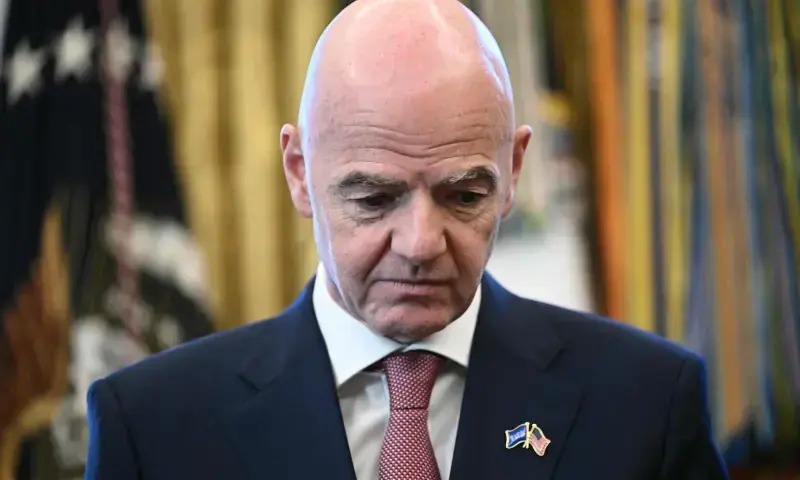
BOLZANO, Italy: FIFA President Gianni Infantino is facing growing pressure from some of football’s most influential regional confederations, with UEFA, the Asian Football Confederation (AFC) and CONCACAF discussing the possibility of a no-confidence vote aimed at removing him from office.
The discussions follow Infantino’s controversial proposal to sell private investors a stake in a new FIFA commercial entity that would control the commercial rights to the World Cup. The plan triggered strong opposition from several major confederations over concerns about transparency, consultation and governance.
Senior figures familiar with the discussions told Reuters that the three confederations are considering whether to pursue a no-confidence motion. If such a vote takes place, it would be unprecedented in FIFA’s 122-year history, as there is no known previous case of the FIFA Congress holding a no-confidence vote against a sitting president.
One source familiar with the discussions said Infantino now faces two possible paths: stepping aside voluntarily and deciding not to contest the March election, or facing a more difficult challenge through a possible no-confidence vote.
Under FIFA’s statutes, the FIFA Council can call an Extraordinary Congress at any time. It is also required to convene one if at least one-fifth of FIFA’s 211 member associations submit a written request identifying the matters they want placed on the agenda.
The Extraordinary Congress must then be convened within three months, with every association attending the meeting entitled to one vote. FIFA’s statutes, however, do not contain a specific provision dealing with a no-confidence vote against the president.
FIFA has previously said it would not support, facilitate or tolerate any process related to the FIFA presidency that does not comply with its statutes, democratic procedures and established governance framework.
UEFA has not directly confirmed whether a no-confidence vote is being discussed. Instead, it has repeated its earlier call for a “thorough and fundamental” review of FIFA’s leadership and governance, adding that “no option should be off the table”.
CONCACAF has also declined to comment directly on the issue, pointing to its previous joint statement with UEFA and the AFC, in which the three confederations accused FIFA leadership of a fundamental breach of trust. The AFC has not immediately responded to requests for comment.
Infantino Still Plans to Seek Re-election
Infantino has said he intends to seek another term at the FIFA Congress scheduled for March 2027 and continues to have support from a significant number of FIFA member associations.
The Confederation of African Football (CAF) remains among his supporters. CAF President Patrice Motsepe said last week that Infantino continued to have Africa’s backing and that his future should ultimately be decided by FIFA members through the election.
FIFA has also apologised to its member associations over mistakes made in the handling of the investment proposal. Six Arab football associations, including Qatar and 2030 World Cup co-host Morocco, publicly backed Infantino last week.
FIFA leadership reaffirmed its full support for the president following a crisis meeting in Morocco earlier this month.
However, those seeking a no-confidence vote are concerned about the consequences of an unsuccessful challenge. A failed attempt could demonstrate that Infantino still commands enough electoral support and could strengthen his position ahead of next year’s presidential election.
World Cup Investment Plan Sparks Crisis
The dispute intensified after Infantino’s proposal to sell a minority stake in a new FIFA commercial entity to private investors collapsed.
The proposed entity would have controlled the commercial rights to the World Cup, FIFA’s flagship event.
FIFA expects its revenue for the 2023-2026 cycle to exceed $15 billion, with most of that income expected to be generated during the 2026 World Cup year.
UEFA, AFC and CONCACAF were among the three of FIFA’s six continental confederations that opposed the investment proposal. They subsequently criticised the way the project was handled, raising concerns about transparency, consultation and governance.
The crisis deepened following the departure of FIFA Chief Operating Officer Kevin Lamour. Lamour had criticised the investment proposal and said staff had been misled about what he described as a project driven by one individual. FIFA did not give a reason for his departure.
FIFA Vice President Sandor Csanyi also withdrew his support for Infantino, describing Lamour’s departure as the “final straw”.
Opposition Faces Major Obstacles
Despite the growing criticism, Infantino’s opponents still face significant challenges.
No challenger had publicly entered the race ahead of the November 18 nomination deadline in the original Reuters report, while Infantino continued to retain support from parts of FIFA’s membership.
Under the abandoned investment proposal, FIFA member associations could have received up to $20 million in one-time funding for infrastructure, coaching, national teams, competitions, grassroots football and the women’s game.
Football Association of Malawi President Fleetwood Haiya previously called on anyone seeking to challenge Infantino at the ballot box to come forward and explain what they would offer to member associations.
Clubs Add Pressure
The dispute has also expanded beyond the FIFA voting structure.
European Football Clubs (EFC), chaired by Paris Saint-Germain president Nasser Al-Khelaifi and representing more than 800 clubs, is reportedly aligned with UEFA and other groups calling for changes at FIFA.
EFC has warned FIFA that its members could refuse to participate in future men’s and women’s Club World Cups unless concerns surrounding governance and the relationship between clubs and FIFA are addressed.
Although clubs do not have a vote in FIFA presidential elections, they possess substantial sporting and commercial influence.
Michael Payne, a former International Olympic Committee marketing chief, said even an electoral victory for Infantino would not necessarily resolve the divisions within world football.
He argued that winning with a narrow majority while many of the sport’s biggest powers oppose the president would still leave serious questions about how FIFA could be effectively governed.
No FIFA sponsor has publicly criticised Infantino over the dispute. Payne said sponsors were nevertheless questioning how FIFA could follow a successful World Cup with such a serious internal crisis.
Pressure Continues to Grow
The pressure on Infantino has continued to increase, with major confederations and national associations reassessing their support. On Saturday, CONCACAF President Victor Montagliani reportedly asked Infantino not to attend a youth tournament in the Dominican Republic, citing concerns that his presence would draw attention away from the event amid the ongoing governance dispute.
At the same time, reports indicate that potential alternatives to Infantino could be emerging ahead of the 2027 election, although no final challenger has been confirmed.
For those involved in discussions over a possible no-confidence vote, the dispute has already caused lasting damage to FIFA’s internal relationships.
The question now is whether the growing opposition will lead to an unprecedented challenge against Infantino or whether he will be able to maintain enough support to remain in control of FIFA.




Leave a Reply